

Family Law Matters Scotland

Categories
Children Cohabitation Divorce International Family Law

Civil Remedies for Domestic Abuse

Civil Remedies for Domestic Abuse

Abuse can come in many different forms; physical abuse, emotional abuse, financial abuse and coercive control to name a few. Sadly, it is not uncommon for one party in a relationship to come to us and explain that they have experienced, or continue to experience, some form of abuse or violence from their ex-partner.

Section 1 of the Domestic Abuse (Scotland) Act 2018 makes it an offence for a person to engage in a course of behaviour which is abusive towards a partner or ex-partner; if a reasonable person would consider that the behaviour was likely to cause the other person physical or psychological harm; and the perpetrator either intended the victim to suffer such harm or was reckless as to whether their behaviour was likely to cause such harm. 

If your ex-partner has behaved in a manner that is threatening, abusive and/or placing you in a state or fear, alarm or distress you should firstly contact the police to make them aware of the situation and see what action they can take depending on your specific circumstances. However, there are also a number of civil orders which can be sought to better protect you, whether in the course of ongoing family law proceedings or not.


  1. Interim Interdicts:

An Interim Interdicts is a particularly useful order, which can be sought urgently in civil proceedings at a pre-service hearing. This means that the order can be granted against an individual before any court papers are served on them. The interim interdict will then take effect once the papers are served.

A Non-Molestation Interdict (as it is commonly known), can have specific wording relating directly to the facts of your circumstances but in general will seek to prevent your ex from ‘molesting’ you by abusing you verbally, by threatening you, by putting you into a state of fear, alarm or distress or from using violence towards you. This is a common law interdict and the legal test is the balance of convenience. That means the question for the Sheriff will be whether it is more convenient than not to grant the interim order.  

Where children are involved, and depending on the circumstances of your case, it may also be possible to seek an interim interdict against removal of the child/children from your care in terms of Section 11 (2)(f) of the Children (Scotland) Act 1995.


  1. Power of Arrest:

A power of arrest can be attached to an interdict in terms of Section 1 of the Protection from Abuse (Scotland) Act 2001. The court must attach a power of arrest to the interdict only if satisfied of the following:

  • the opponent has had the opportunity of being heard; and
  • that the attachment of a power of arrest is necessary for the protection of the applicant from risk of abuse in breach of the interdict.

A power of arrest means that a police constable may arrest your ex-partner without a warrant if they have reasonable cause for suspecting that they are in breach of the interdict that has been granted and consider that, if they are not arrested, there would be a risk of abuse or further abuse in breach of the interdict. A power of arrest may remain in effect for a period of one to three years. The duration will ultimately be determined by the Sheriff granting the order.


  1. Determination of Domestic Abuse Interdicts

Section 3 of the Domestic Abuse (Scotland) Act 2011 provides that a person who is applying for, or who has obtained, an interdict may apply to the court for a determination that the interdict is a domestic abuse interdict. The court may make a determination if satisfied that the interdict is granted for the protection of the applicant against a person who is (or was) the applicant’s spouse/civil partner, living with the applicant as if they were spouses/civil partners, or in an intimate relationship with the applicant.

If an interdict has been determined a domestic abuse interdict, and your ex-partner breaches the interdict, they will automatically be guilty of an offence which may lead to a summary conviction or a conviction on indictment. Breach of an ordinary interdict would only have civil consequences.

You may also be advised about an Exclusion Order where your ex has occupancy rights to your home, or a Non-Harassment Order.

If you, or anyone you know is experiencing abuse with a current or former partner you should initially contact the police for urgent assistance.

For more advice about the civil remedies for domestic abuse, and all other family law matters, please contact us on 0141 420 2430 or emails us at reception@flmscotland.co.uk.


The content of this webpage is for information only and is not intended to be construed as legal advice and should not be treated as a substitute for specific advice. Family Law Matters Scotland LLP accepts no responsibility for the content of any third party website to which this webpage refers.

Categories
Children Cohabitation Divorce International Family Law

Child Inclusive Mediation

Child Inclusive Mediation

Mediation is a confidential, voluntary process which involves parties meeting with an independent third party, the mediator, who assists them in identifying the issues that require to be resolved between them and in developing suitable solutions that are acceptable to both parties. The mediator is a specially trained, impartial person who facilitates discussions and negotiations between the parties.

Family Law Mediation has seen a recent surge in interest as the courts have begun to actively encourage parties to attend mediation where possible rather than litigate matters. In appropriate cases, the Scottish Courts can also refer parties to mediation if it is viewed this would be a more successful.

Family Law Mediation can assist parties in negotiating a financial settlement on separation, and in considering what care arrangements are best for their children. In Scotland, until very recently, children were not previously involved in the mediation process but this is now set to change.

Our Consultant Janie Law has extensive experience as a Family Law Mediator and has now become one of twelve solicitors in Scotland to be trained in Child Inclusive Mediation (CIM). CIM provides the opportunity for a child to meet separately with the mediator to provide their views on the disputed matter. This is an entirely voluntary process both for the child and the parties who are in dispute. Not only does CIM enable children to be involved in the mediation process, but it promotes the opportunity for children to express their views and have their voices heard which is particularly crucial in contact/residence disputes.

It is important to highlight, as with children giving their views during the course of litigation, they do not become the decision maker but simply allows them to feel heard and provides the disputed parties with the opportunity to consider not only what they think is best for the child but also what the child thinks. Often this can ensure any decisions ultimately made are more successful in practice.

For more information about mediation and advice/assistance on beginning the process, please contact us on 0141 420 2403 or email us at reception@flmscotland.co.uk. 

The content of this webpage is for information only and is not intended to be construed as legal advice and should not be treated as a substitute for specific advice. Family Law Matters Scotland LLP accepts no responsibility for the content of any third party website to which this webpage refers.

Categories
Children Cohabitation Divorce International Family Law

Can I rely on a Separation Agreement?

Can I rely on my Separation Agreement?

When a marriage or civil partnership breaks down, the norm is for each party to take independent family law advice on their entitlement to financial provision on divorce/dissolution. Usually parties will then agree, through their lawyers, how their assets should be divided. Their lawyers will then encapsulate that agreement into a legally binding contract which is often referred to as a Separation Agreement (Agreement). This Agreement will contain a discharge clause which prevents either party from asking the court to award them any further financial provision beyond that which has been set out in the Agreement.

However, is the Agreement the end of the story? The answer is usually, but there can be exceptions to the rule! In terms of s.16 of the Family Law (Scotland) Act 1985, either party can ask the court to set aside the Agreement if it was not fair or reasonable at the time it was entered into. Although cases raised under s.16 are relatively rare, the provision was considered recently by the Sheriff Appeal Court in the case of Bryce v Bryce [2023] SAC (Civ) 36. The parties had separated on 7 March 2019 and, very soon after, had entered into an Agreement on 23 April 2019. The wife later raised proceedings to set aside the Agreement as it was not fair or reasonable. The Sheriff who first heard the case refused to do so on the basis of the five principles set out in the leading case of Gillon v Gillon (No. 3) 1995 SLT 678, namely :-

(a) it is necessary to examine the agreement from the point of view of both fairness and reasonableness;

(b) the examination must relate to all relevant circumstances leading up to and prevailing at the time the agreement was made, including the nature and quality of any legal advice given to either party;

(c) evidence that one party had taken some unfair advantage of the other by reason of the prevailing circumstances at the time of the negotiations may have a cogent bearing on the determination of the issue;

(d) the court should not be unduly ready to overturn agreements validly entered into; and

(e) the fact that an agreement led to an unequal (and possibly very unequal) division of assets does not by itself necessarily give rise to any inference of unfairness and unreasonableness.

In Gillon the court had held that the agreement which divided the assets unequally was fair and reasonable nonetheless. The terms had been agreed before the significant value of the defender’s pension was known but the pursuer still benefited substantially from the Agreement, both parties had had separate legal representation and advice, and, at the time the agreement had been entered into, the existence of the defender’s pension rights was known to both parties.

The Minute of Agreement in the Bryce case provided that the wife receive 8.5% of the value of the matrimonial property and the husband 91.5%. The Sheriff found that although these figures suggested an unfair and unreasonable agreement at first glance, when he considered the surrounding circumstances in terms of Gillon, he found the Agreement should stand. These circumstances included the disclaimer that the wife had signed confirming that she had been given the opportunity to take independent legal advice but had declined to do so, that she did not have poor mental health or any intellectual impairment, that the husband’s solicitor had acted only for the husband and the wife was informed that she could obtain independent legal advice. The Sheriff found that it was the wife’s choice to enter into the Minute of Agreement and that the imbalance created by the Agreement resulted from her own failure to protect her position. 

However, the Appeal Court found that the Sheriff had wrongly applied the Gillon principles. The agreement was not fair because of the enormous imbalance in the division of property which was not counterbalanced by any significant benefit to the wife. Further, it was not reasonable as it did not take any account of the value of the former matrimonial home nor of the value of the husband’s pension as these had not been valued at the time of signing and the wife did not appear to know about her entitlement to share in her husband’s pension. Finally, it was neither fair nor reasonable as it was signed when the wife had not received legal advice and she was under the mistaken impression that the husband’s solicitor may have been acting for both parties. Accordingly, they ordered that the agreement should be set aside.

Clients will often think that it is easier and cheaper if their estranged spouse/civil partner has no solicitor and sometimes, they also think that this means that they will be able to retain more than a fair share of the matrimonial property. The Bryce case demonstrates, however, that this approach could go horribly wrong. The husband in the Bryce case was found liable for the wife’s appeal procedure expenses which he will have to pay on top of the initial expense of negotiating the fated Agreement and his own legal expenses in the ensuing litigation. He will also then require to pay further legal costs in relation to re-negotiating the terms of a fresh Separation Agreement based on a fair sharing of the assets, or indeed of a divorce litigation if terms cannot be agreed – this is no doubt a matter of deep regret and is a cautionary tale to all family lawyers who are negotiating with an unrepresented party.

For advice and assistance in relation to separation and divorce, and all other family law matters, please contact us on 0141 420 2403 or email us at reception@flmscotland.co.uk. 

The content of this webpage is for information only and is not intended to be construed as legal advice and should not be treated as a substitute for specific advice. Family Law Matters Scotland LLP accepts no responsibility for the content of any third party website to which this webpage refers.


Morven joined Family Law Matters in 2023. She has practised exclusively in the field of family law since qualifying as a solicitor in 2003.

N.B Please note the contents of this Blog do not constitute any form of legal advice and you should always obtain individual advice as to your rights from a family lawyer.

Categories
Children Divorce International Family Law

What is the likelihood of me being able to get my ex-partner’s parental rights and responsibilities removed

wHAT IS THE LIKELIHOOD OR ME BEING ABLE TO GET MY EX-PARTNERS' PARENTAL RIGHTS AND RESPONSIBILITIES REMOVED?

The answer to this question is likely to be “not high” though it will, of course, depend on the circumstances of your case. An order depriving a parent of their responsibilities and rights was described by Sheriff Reid in the recent case of AB v CD [2024] SC KDY 2 as “a (or perhaps the) most profound interference with a party’s rights under Art.8 of the European Convention on Human Rights”. Accordingly, the Court must be satisfied that the order sought is proportionate and there is no less draconian, but equally effective way, of securing the best interests of the child.

The parties in AB v CD were the parents of an 11-year-old child – “Andrew”. Following the parties’ separation in 2017, Andrew lived with his mother and had contact with his father. In 2018 the court made an order reducing that contact to nil following allegations that the father had assaulted and sexually assaulted the mother and her three older children (not the father’s children). He was ultimately convicted of these offences and imprisoned. The pursuer sought to remove the father’s parental rights and responsibilities (PRR) under s.11(2)(a) of the Children (Scotland) Act 1995 on the basis that the continuation of these rights caused her stress and anxiety and that Andrew had no relationship with his father and would not miss it.

As with any application for an order under s.11 of the 1995 Act, the Sheriff considered the case on the basis that Andrew’s best interests were his paramount consideration. In his judgment, his Lordship found that it was not better for Andrew that the father’s parental responsibilities and rights were removed and refused the order. The principal factors that were relevant to the Sheriff’s decision were as follows :-

1.  The continuation of the father’s PRR did not pose a direct threat to Andrew

2. The mother’s desire for a clean break from the father carried little weight

3. There was no evidence that the mother’s stress and anxiety about the continuation of the father’s PRR was such that she had a diagnosable psychological or psychiatric condition

4. There was no evidence of a wider effect upon the pursuer’s family.

5. There was no evidence of an adverse effect on Andrew

6. That the order were made, Andrew would be legally orphaned

As a fall-back position the mother had asked the Sheriff to suspend the father’s PRR. Sheriff Reid refused to suspend the right of residence as doing so would make no difference as the mother already had a residence order. Similarly, he refused to suspend the father’s right and responsibility to maintain personal relations with Andrew given the terms of the existing contact order.

Sheriff Reid did agree, however, to suspend the father’s right and responsibility to act as Andrew’s legal representative along with the father’s responsibility to safeguard and promote Andrew’s health, development and welfare. He also suspended the father’s right to control, direct or guide Andrew. The corresponding responsibility was not suspended as it was effectively already limited by the contact order.

Finally, he ordered that, given the defender would have no direct role in Andrew’s life, that the pursuer should be entitled to remove Andrew from the United Kingdom without the defender’s consent.

For Sheriff Reid the orders struck the appropriate balance between protecting the child, giving the mother the certainty and security, she needed but, did not close the door entirely on the possibility of the defender and Andrew re-establishing a relationship in the future. This may be a surprising outcome to some readers and also acts as a reminder that robust evidence, medical evidence in particular, will be needed if the parent seeking to deprive the other parent of their PRR is claiming that the impact on them will have an indirect adverse impact on the child. 

For advice and assistance in relation to parental rights and responsibilities, and all other family law matters, please contact us on 0141 420 2403 or email us at reception@flmscotland.co.uk. 

The content of this webpage is for information only and is not intended to be construed as legal advice and should not be treated as a substitute for specific advice. Family Law Matters Scotland LLP accepts no responsibility for the content of any third party website to which this webpage refers.


Morven joined Family Law Matters in 2023. She has practised exclusively in the field of family law since qualifying as a solicitor in 2003.

N.B Please note the contents of this Blog do not constitute any form of legal advice and you should always obtain individual advice as to your rights from a family lawyer.

Categories
Divorce International Family Law

How will our assets be divided on Divorce/Dissolution?

How will our assets be divided on Divorce/Dissolution?

When married or civil partnered individuals separate, the law which applies to the division of their assets is found in the Family Law (Scotland) Act 1985. In terms of that Act, the parties’ matrimonial /partnership property should be shared fairly. “Fairly” can often mean equally but there is provision in the Act for unequal sharing in certain circumstances.  However, such unequal sharing is entirely at the discretion of the Judge or Sheriff who is dealing with the case. Often, they will find that the respective parties’ arguments for unequal sharing negate each other and will simply order equal sharing of the assets.


In fact, this is exactly what happened in the recent case at Aberdeen Sheriff Court, LM v AM [2023] SC ABE 34. Here there were three unequal sharing arguments which all failed and the Sheriff found that the net assets should be shared equally. Firstly, the husband argued that the value of the matrimonial home should be shared unequally due to pre-marriage funds that he had injected into the purchase of an earlier property which the parties had bought. However, the Sheriff accepted the wife’s evidence that she had provided a largely equal sum. Accordingly, taking a broad-brush approach, the Sheriff held that the matrimonial home should be sold and the net free proceeds shared equally.

It is possible to seek unequal sharing where one party will bear more than half of the costs associated with caring for a child of the parties who is under 16. The wife made this argument but provided no evidence of those costs or the accommodation that she would require to acquire for her and her son to live in. On the basis of her earnings, the Sheriff was satisfied that an equal sharing of the assets would be sufficient for her to secure suitable accommodation in any event and found no basis on which to order unequal sharing.

The third argument related to the parties’ heritable properties. The wife argued that she had been economically disadvantaged as the parties’ jointly owned flat had been rented out and the husband had retained all of the rent. The husband claimed he had been disadvantaged as he had paid the outgoings on the property to which the wife had made no contribution. The Sheriff found that the husband had paid significantly more than the wife in relation to the combined mortgage payments on the flat and the matrimonial home whilst the wife had had exclusive occupation of the matrimonial home since separation. On that basis and employing his “broad axe”, he accordingly found that there should be equal sharing in relation to the flat.  

The Sheriff commented at various points that the evidence was either non-existent, vague, or unsatisfactory. This case is therefore very much a cautionary reminder to anyone contemplating a litigation where they are arguing for more than a one-half share of the assets. Due to the breadth of the Sheriff’s discretion in this regard, this is very risky, particularly where you do not have robust evidence to support your case. If a party takes a case all the way to a final hearing and is unsuccessful, there is also the significant risk that they will be found liable for the other party’s judicial expenses as well as having to meet all of the costs related to their own case. The cost implications for parties are, accordingly, considerable, not to mention the polarising effect that the litigation will likely have on them. This is particularly undesirable for parties with children whom they may be co-parenting for some time to come.

Court should always be the last resort. there are many other ways to navigate the financial aspects of a separation, for example; mediation, negotiation, collaborative law, or arbitration. It is also always important to consult a family law specialist prior to getting married or entering a Civil Partnership to discuss the drafting of a Pre-Nuptial Agreement. This can significantly limit the scope for unequal sharing arguments, and the associated expense and update, in the event of a future separation. 

For advice and assistance in relation to separation and divorce, and all other family law matters, please contact us on 0141 420 2403 or email us at receptin@flmscotland.co.uk. 

The content of this webpage is for information only and is not intended to be construed as legal advice and should not be treated as a substitute for specific advice. Family Law Matters Scotland LLP accepts no responsibility for the content of any third party website to which this webpage refers.


Morven joined Family Law Matters in 2023. She has practised exclusively in the field of family law since qualifying as a solicitor in 2003.

N.B Please note the contents of this Blog do not constitute any form of legal advice and you should always obtain individual advice as to your rights from a family lawyer.

Categories
Children Divorce International Family Law

Relocation of Children: M v A [2023] CSOH 80

Relocation of Children : M v A 2023 [CSOH] 80

In my last blog about relocation, I looked at the case of W v W [2023] CSOH 72 in which Lord Stuart refused a mother’s application for her son to relocate from Scotland to France. In M v A [2023] CSOH 80 Lord Stuart was faced with another relocation application, this time within Scotland, and in quite unusual circumstances. However, unusual as it was, the test that Lord Stuart had to apply when considering the application was still the usual welfare test and whether the relocation would be in the best interests of the children or not.   

In M v A, the mother was the primary carer of the children aged 2 and 4. Before January 2023, the father, who was making the application for the children to relocate, had exercised intermittent contact with the children who had lived in Aberdeen with their mother since September 2022. From January 2023 the father began exercising alternate weekend contact with them in Glasgow. However, unlike in most relocation cases, he was not also seeking a residence order and agreed that the mother should continue to be the primary carer. Therefore, unusually, in practical terms, he was not only seeking relocation of the children but of their mother too.

Lord Stuart refused the application on the basis that the children were well settled in Aberdeen and based this decision on a number of factors. He considered that they lived in appropriate accommodation. Further, their mother was is in good employment in Aberdeen, with prospects of promotion and was therefore in a secure position to provide for the children. In terms of education, he found that the children attended a reputable nursery in Aberdeen where they were doing well and from which they would progress along with their peers in the usual way. He also found that no better health provision existed in Glasgow compared to Aberdeen.

The children’s mother was a Latvian national and in Aberdeen she and the children were part of a community of adults and children who supported both their Scottish and Latvian heritages. This was an important factor in favour of staying in Aberdeen as this could not be replicated in Glasgow. Further, the children’s paternal grandparents lived in St Andrews which was equidistant between Glasgow and Aberdeen and so were able to be a meaningful part of the children’s lives whether they were in Aberdeen or Glasgow.

Whilst Lord Stuart accepted that the distance between the children and the father did have a negative impact on the children’s ability to have direct contact with him, the father had said in evidence that he would consider moving to Aberdeen if he was unsuccessful in the application. Further, the father’s employment was temporary and his home was not his own but rather was owned by a family trust. This was in direct contrast to the mother’s home and employment situation which provided a solid and stable environment for the children.

Accordingly, Lord Stuart saw little, if any, benefit in requiring the children to relocate to Glasgow and was of the view that their circumstances could be improved by the pursuer taking action rather than the children. Throughout the evidence Lord Stuart considered that the father’s application appeared to be based on what he wanted as opposed to what was objectively in his children’s best interests.

This case reminds us that if children are thriving in the status quo, then an application to relocate them elsewhere is very likely to be unsuccessful. It is important that clients are aware of the hurdles they will face if they wish to raise an action for relocation given the significant cost implications of doing so, not to mention the potential destruction of any remaining relationship with the other parent and the ramifications of that for continued co-parenting. 

For advice and assistance in relation to child relocation, and all other family law matters, please contact us on 0141 420 2403 or email us at reception@flmscotland.co.uk. 

The content of this webpage is for information only and is not intended to be construed as legal advice and should not be treated as a substitute for specific advice. Family Law Matters Scotland LLP accepts no responsibility for the content of any third party website to which this webpage refers.


Morven joined Family Law Matters in 2023. She has practised exclusively in the field of family law since qualifying as a solicitor in 2003.

N.B Please note the contents of this Blog do not constitute any form of legal advice and you should always obtain individual advice as to your rights from a family lawyer.

Categories
Children Divorce International Family Law

Enforcement of Foreign Child Orders in Scotland

Enforcement of Foreign Child Orders in Scotland

We regularly have international clients asking for assistance either in dealing with child orders that they already have from a foreign court or where clients are embarking on foreign court procedure in relation to their children, such as a divorce, and they wish to make sure that such foreign court child orders can be dealt with in a Scottish court if necessary.


In Scotland there is not one procedure that can be used that allows this to happen. How we tackle this very much depends on which country’s foreign orders we are dealing with. There are international conventions and treaties that the UK is signed up to with a variety of countries around the world that provides for mechanisms for the enforcement of foreign court orders in Scotland.

If I use Australia as an example and a Scottish ex-pat who previously immigrated to Australia has separated from her husband and wishes to relocate to Scotland with the child of the marriage. The husband will agree to the relocation but only if his contact arrangements are in court orders that can be enforced in both Australia and Scotland. In that particular situation, Scotland and Australia are signatories to the 1996 Hague Convention which is an international treaty which deals mainly with jurisdiction in parental rights and responsibility cases but also provides for the registration and enforcement of child orders between the various contracting states of the convention. I can use the 1996 Hague Convention to register an order dealing with the childcare arrangements from the Australian court in the Court of Session in Scotland and then when registration has been completed, and only if it is necessary, the husband could enforce the order in Scotland. The Scottish court will treat the registered Australian order as if it were an order the Scottish court had made.

This can be a complicated area of law and it is essential therefore to obtain advice from international family lawyers such as ourselves who can identify the correct law and procedure to use. Hopefully this will allow international families to agree arrangements for their children in the safe knowledge that any orders made can be enforced in their respective countries. 

For advice and assistance in relation to the registration and enforcement of foreign child orders in Scotland, and all other family law matters, please contact us on 0141 420 2403 or email us at receptin@flmscotland.co.uk. 

The content of this webpage is for information only and is not intended to be construed as legal advice and should not be treated as a substitute for specific advice. Family Law Matters Scotland LLP accepts no responsibility for the content of any third party website to which this webpage refers.


Marisa Cullen

Marisa joined Family Law Matters Scotland LLP as a partner in 2021. Marisa has been practicing law since 2005. She is double accredited by the Law Society of Scotland as a specialist in both family law and child law.

N.B Please note the contents of this Blog do not constitute any form of legal advice and you should always obtain individual advice as to your rights from a family lawyer.

Categories
Children Cohabitation Divorce International Family Law

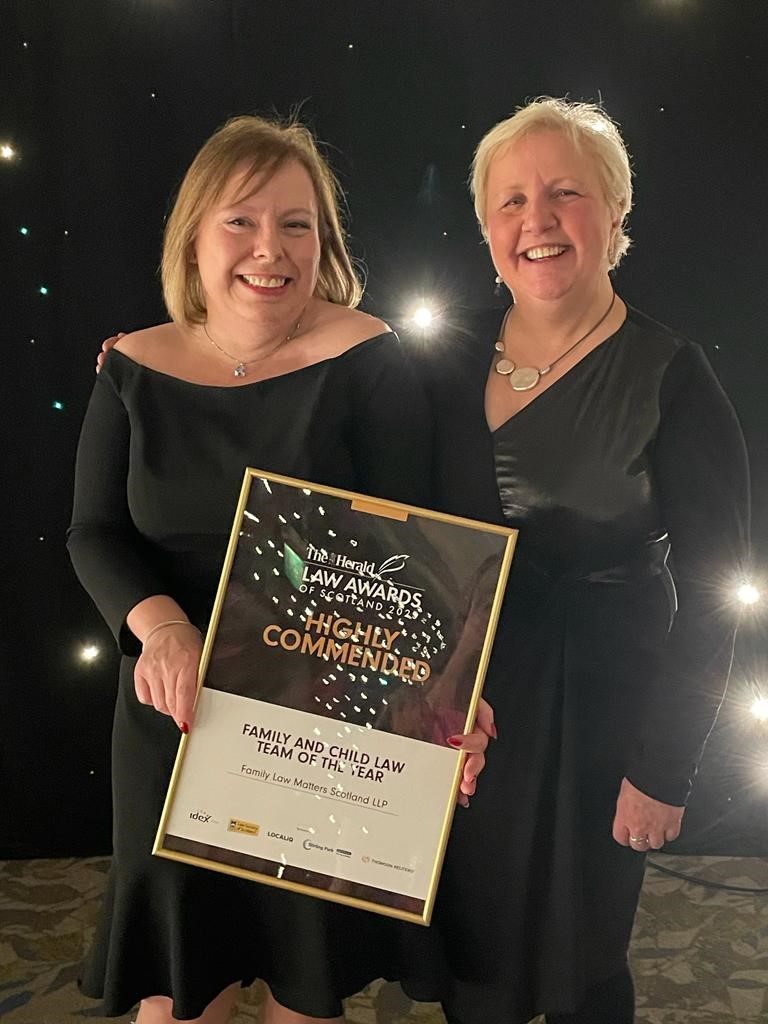
Highly Commended Family and Child Law Firm of the Year 2023

Highly commended Family and Child Law Firm of the Year 2023

We are extremely honoured that Family Law Matters Scotland were recognised at the ‘Highly Commended’ Family and Child Law Firm of the Year 2023 at the Herald Law Awards 2023 as well as being a finalist for Family and Child Law Team of the Year. This is a true testament to our dedicated and hard-working staff who are committed to providing top quality service to our clients.

Our Karen Gailey and Janie Law had a brilliant night at the Awards celebrating with our friends and colleagues. Congratulations to all the winners and nominees.


Categories
Children Divorce International Family Law

Relocation of Children

Relocation of Children

When faced with a parent’s request to allow their child to relocate out with the UK, it is settled law in Scotland that the court’s decision is based solely on the best interests of the child irrespective of how much time the child spends with each parent. In England, the leading case of Payne v Payne [2001] EWCA Civ 166, on the other hand, confirmed that, whilst the child’s best interests were paramount, great weight had to be accorded to the reasonable plans of a parent with a residence order. Having said that, although this decision has not yet been overturned by the Supreme Court or by the enactment of new legislation, the English courts can now be seen to be moving more towards the Scottish “presumption free” approach.

Relocation was the main focus of the recent case of W v W [2023] CSOH 72 where the father opposed the mother’s request for their 3-year-old son to relocate to France. The father had been born and raised in Scotland. His wider family all lived close by. The mother had been born in France but had moved to Scotland where she had lived since 2011. The mother’s extended family lived in France. The parties had separated in December 2021. By June 2022 the parties had equal care of their son and, at that point, the father agreed to allow relocation to France in the summer of 2023. In May 2023 he withdrew his consent.

The parties were agreed that each parent gave an excellent standard of care to the child and that he had devoted families in Scotland and France. They also agreed that he was happy at nursery and that he was thriving, happy and well adjusted.

Lord Stuart presided over the case and confirmed the test for relocation cases, namely that the child’s welfare was paramount and that the court had to weigh up all relevant factors in the case before making a decision. The Scottish approach is entirely “presumption free” and no particular factor has greater weight than any other. Everything depends on the child involved and their unique circumstances.

Lord Stuart confirmed that it was for the mother to show that (1) relocation would be in the best interests of the child and (2) that from the child’s perspective, it would be better to allow relocation than to make no order. It was of no consequence that the father had previously agreed to the relocation.

When assessing the evidence, Lord Stuart based his decision on five main areas :- 1) relationship with parents, including maintenance of contact, 2) wider family relationships and childcare, including family support, 3) employment, 4) accommodation, and 5) education.

Lord Stuart found the position to be largely neutral in relation to the areas of employment, accommodation, and education. However, the evidence in relation to the first and second areas shaped his decision. He found if the child relocated, it would fundamentally undermine both the important and beneficial presence of the father in the child’s life and the child’s desire for physical contact with him. The holiday contact and indirect contact proposed by the mother was a poor substitute and not in the child’s best interests. For his Lordship, the reduction of the child’s relationship with his father and the role his father played in his life would be the most significant disadvantage to the child. He also found that relocation would significantly reduce the benefits that the child derived from his interactions with the father’s extended family.

This case is a reminder that pursuing an order for relocation will be an extremely challenging task where there is a close relationship with the other parent. As Lord Stuart said in W v W, in that situation, there would have to be clear evidence of significant benefits to the child in other areas before the court could conclude that the negative effect on the relationship between the left behind parent and the child was sufficiently offset to demonstrate that relocation was in the child’s best interests. Examples may be where the child has particular medical or educational needs that would be best served in the other country.

For advice and assistance in relation to child relocation, and all other family law matters, please contact us on 0141 420 2403 or email us at reception@flmscotland.co.uk. 

The content of this webpage is for information only and is not intended to be construed as legal advice and should not be treated as a substitute for specific advice. Family Law Matters Scotland LLP accepts no responsibility for the content of any third party website to which this webpage refers.


Morven joined Family Law Matters in 2023. She has practised exclusively in the field of family law since qualifying as a solicitor in 2003.

N.B Please note the contents of this Blog do not constitute any form of legal advice and you should always obtain individual advice as to your rights from a family lawyer.

Categories
Children Divorce International Family Law

Sophie Turner and Joe Jonas: A case of wrongful retention under the 1980 Hague Convention?

Sophie Turner and Joe Jonas: A case of wrongful retention under the 1980 Hague Convention?

Following their announcement of an amicable split on 6 September, it has been reported that actress Sophie Turner has now raised a Petition under the 1980 Hague Convention seeking the return of the parties two children to England. Although it is now reported that they have reached agreement on an interim contact arrangement which provides for the children to spend equal time in the UK and the US.

While all cases turn on their individual facts, we can consider what Ms Turner would have to establish to raise a successful action for return.

As has been highlighted in my colleagues’ previous blogs, the 1980 Hague Convention seeks to secure the prompt return of children wrongfully removed to or retained in any contracting state, which includes abductions between England and USA.

In the case of Sophie Turner, it is alleged that her Petition was raised in New York seeking the return of her two children to England after they had been wrongfully retained in America. She states that the family relocated to England earlier this year.

Article 3 of the 1980 Hague Convention states: –

“The removal or the retention of a child is to be considered wrongful where it is in breach of rights of custody attributed to a person, an institution or any other body, either jointly or alone, under the law of the State in which the child was habitually resident immediately before the removal or retention; and at the time of the removal or retention those rights were actually exercised, either jointly or alone, or would have been so exercised but for the removal or retention.”

In order to successfully raise a Petition under the 1980 Hague Convention, Ms Turner’s agents require to show: –

  1. The children are under 16
  2. The children were habitually resident in England prior to the wrongful retention
  3. The wrongful retention is in breach of Ms Turner’s custody right; and that
  4. Ms Turner was exercising her rights of custody prior to the wrongful retention.

Establishing Habitual Residence:

The biggest hurdle in establishing a successful Petition for return is habitual residence. There is no definition of habitual residence in the 1980 Hague Convention but is generally considered to the be the place where a child is integrated in a social and family environment. Habitual residence is a matter of fact that has to be considered on a case-by-case basis.

Ultimately whether the children will be returned to England is a matter for the Judge in New York who will have the opportunity to consider all the facts of the case. In any event, the swift resolution of matters will no doubt be in the best interests of the children and respective parties.

Child abduction cases are particularly sensitive in nature and can have a detrimental impact on the children and parties involved, no matter what the outcome. We always seek to deal with such cases expeditiously and with empathy.

For advice and assistance in relation to child abduction and all other family law matters,  please contact us on 0141 420 2430 or email us at reception@flmscotland.co.uk.
The content of this webpage is for information only and is not intended to be construed as legal advice and should not be treated as a substitute for specific advice. Family Law Matters Scotland LLP accepts no responsibility for the content of any third party website to which this webpage refers.